
Rudolfinerhaus Privatklinik GmbH
Billrothstraße 78
1190 Vienna
Invasive cardiology at Rudolfinerhaus
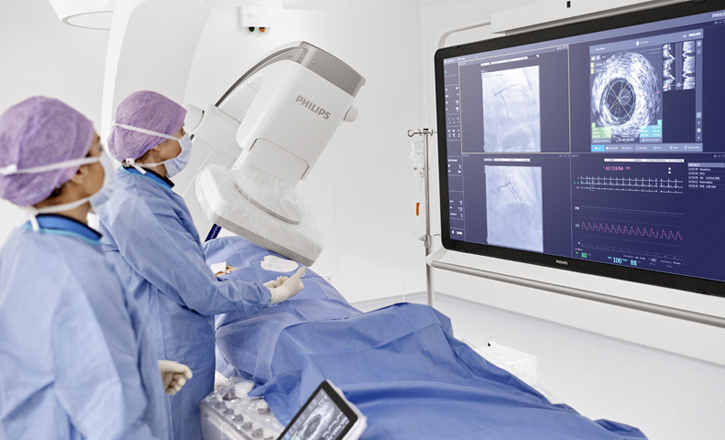
At the interventional cardiology unit of Rudolfinerhaus, we perform more than 800 angiographies per year, making us a leading provider among Austria’s private hospitals. With its new angiography unit, combined with a state-of-the-art contrast medium injection system, Rudolfinerhaus is expanding its capabilities in diagnosis and treatment of cardiac and vascular diseases. These two technologies represent the cutting edge of modern catheterisation laboratories. The innovative imaging technology enables particularly precise procedures whilst reducing exposure to radiation and contrast medium, thereby contributing to a high level of patient safety. Equipped with the latest software, a touchscreen, and an intuitive operating concept, we save many manual steps and thus reduce the time needed to administer the treatment.
We offer the diagnosis and treatment of vascular stenoses and cardiac arrhythmias through:
- Cardiac catheterisation examinations and interventions (PTCA stent)
- Electrophysiological studies & cardiac catheter ablation
- Interventional radiology (peripheral diagnostic and PTAs, e.g. for peripheral arterial disease (PAD), prostate embolisation, joint embolisation, tumour embolisation and renal artery stenting)
Cardiac angiography & intervention
Gentle angiography of the radial artery is performed at Rudolfinerhaus. The catheter is introduced at the wrist. This avoids complications and enhances the comfort of the investigation. Constrictions or obstructions of vessels are identified by cardiac catheterisation and – if necessary– a stent is inserted by balloon dilatation. If you need an intervention in the heart or a bypass, the subsequent treatment is provided in cooperation with the experienced cardiac surgeons at the Medical University of Vienna.
Electrophysiological interventions & cardiac ablation
Cardiac arrhythmia that cannot be controlled with drugs can be eliminated by ablation in the areas causing the arrhythmia. This demanding procedure involves ablation of the source of disease in the heart muscle – and the heart usually returns permanently to its natural rhythm. The revolutionary 3-D technology used at Rudolfinerhaus reduces radiation exposure to a minimum by the use of magnetic navigation systems.
Head of Invasive Cardiology & Angiography
Thomas A. Brunner, MD
Specialist in Internal Medicine & Cardiology
Deputy Medical Director